 Add to Chrome
 Add to Firefox
 Add to Edge
Opportunities in AI/ML for the Rubin LSST Dark Energy Science Collaboration
Jan 20, 2026
The Vera C. Rubin Observatory's Legacy Survey of Space and Time (LSST) will produce unprecedented volumes of heterogeneous astronomical data (images, catalogs, and alerts) that challenge traditional analysis pipelines. The LSST Dark Energy Science Collaboration (DESC) aims to derive robust constraints on dark energy and dark matter from these data, requiring methods that are statistically powerful, scalable, and operationally reliable. Artificial intelligence and machine learning (AI/ML) are already embedded across DESC science workflows, from photometric redshifts and transient classification to weak lensing inference and cosmological simulations. Yet their utility for precision cosmology hinges on trustworthy uncertainty quantification, robustness to covariate shift and model misspecification, and reproducible integration within scientific pipelines. This white paper surveys the current landscape of AI/ML across DESC's primary cosmological probes and cross-cutting analyses, revealing that the same core methodologies and fundamental challenges recur across disparate science cases. Since progress on these cross-cutting challenges would benefit multiple probes simultaneously, we identify key methodological research priorities, including Bayesian inference at scale, physics-informed methods, validation frameworks, and active learning for discovery. With an eye on emerging techniques, we also explore the potential of the latest foundation model methodologies and LLM-driven agentic AI systems to reshape DESC workflows, provided their deployment is coupled with rigorous evaluation and governance. Finally, we discuss critical software, computing, data infrastructure, and human capital requirements for the successful deployment of these new methodologies, and consider associated risks and opportunities for broader coordination with external actors.

A Tutorial on Deep Neural Networks for Intelligent Systems
Mar 23, 2016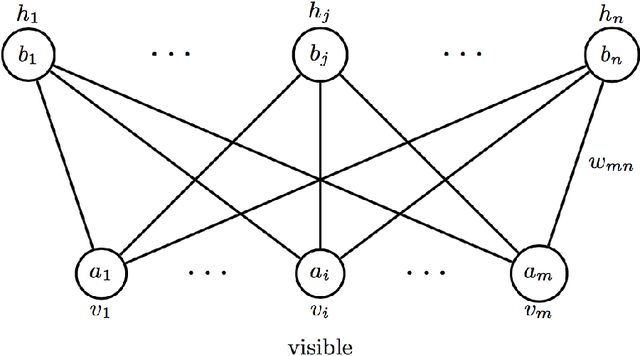
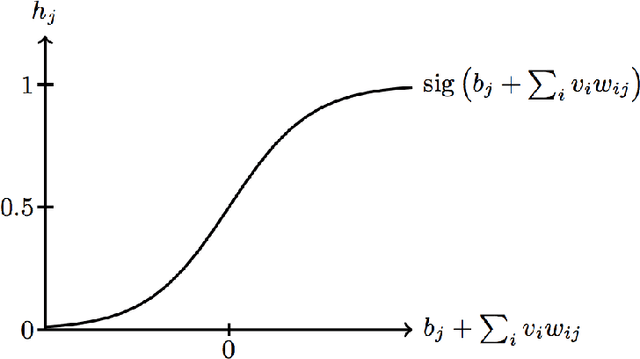
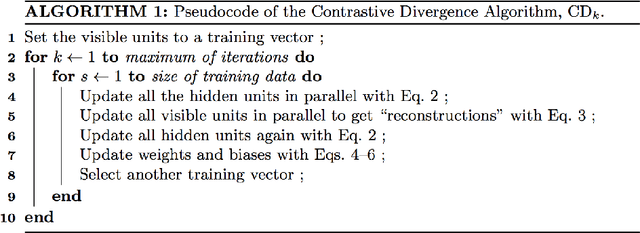
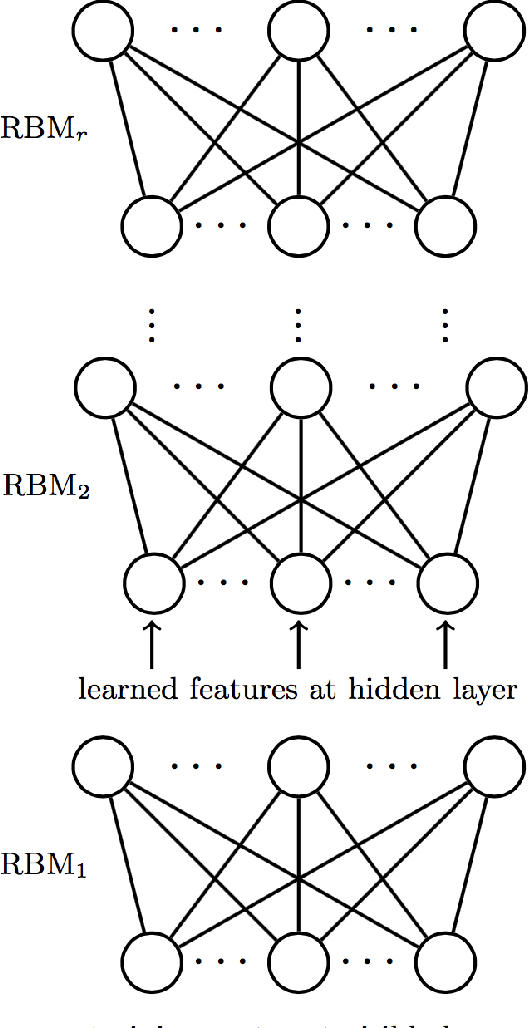
Developing Intelligent Systems involves artificial intelligence approaches including artificial neural networks. Here, we present a tutorial of Deep Neural Networks (DNNs), and some insights about the origin of the term "deep"; references to deep learning are also given. Restricted Boltzmann Machines, which are the core of DNNs, are discussed in detail. An example of a simple two-layer network, performing unsupervised learning for unlabeled data, is shown. Deep Belief Networks (DBNs), which are used to build networks with more than two layers, are also described. Moreover, examples for supervised learning with DNNs performing simple prediction and classification tasks, are presented and explained. This tutorial includes two intelligent pattern recognition applications: hand- written digits (benchmark known as MNIST) and speech recognition.
Uncovering delayed patterns in noisy and irregularly sampled time series: an astronomy application
Aug 25, 2009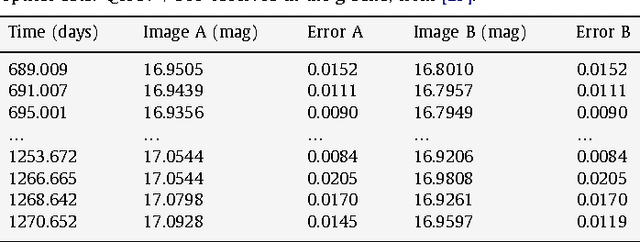
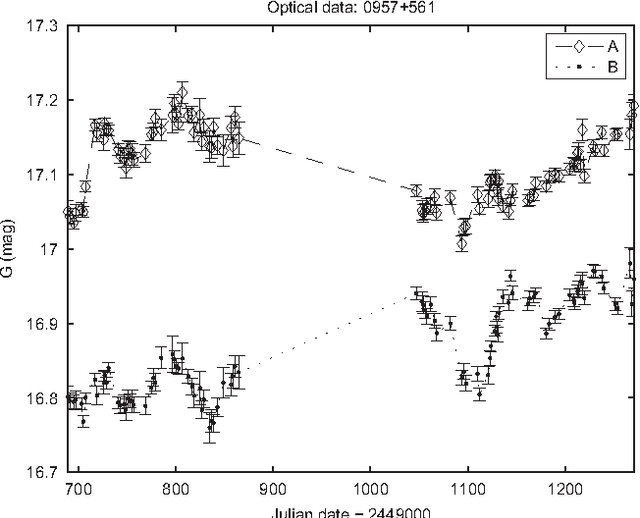
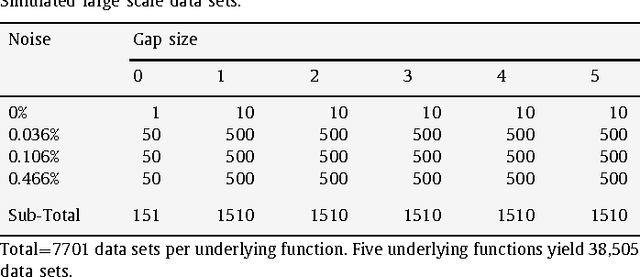
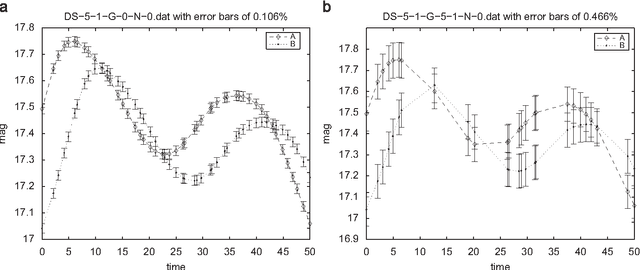
We study the problem of estimating the time delay between two signals representing delayed, irregularly sampled and noisy versions of the same underlying pattern. We propose and demonstrate an evolutionary algorithm for the (hyper)parameter estimation of a kernel-based technique in the context of an astronomical problem, namely estimating the time delay between two gravitationally lensed signals from a distant quasar. Mixed types (integer and real) are used to represent variables within the evolutionary algorithm. We test the algorithm on several artificial data sets, and also on real astronomical observations of quasar Q0957+561. By carrying out a statistical analysis of the results we present a detailed comparison of our method with the most popular methods for time delay estimation in astrophysics. Our method yields more accurate and more stable time delay estimates: for Q0957+561, we obtain 419.6 days for the time delay between images A and B. Our methodology can be readily applied to current state-of-the-art optical monitoring data in astronomy, but can also be applied in other disciplines involving similar time series data.
How accurate are the time delay estimates in gravitational lensing?
May 01, 2006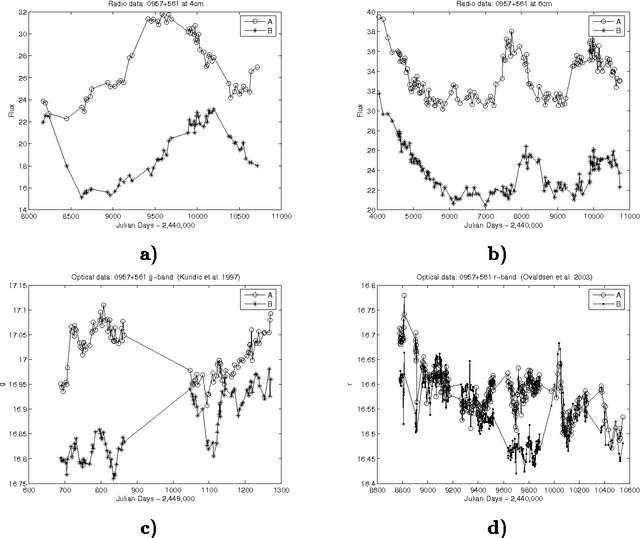
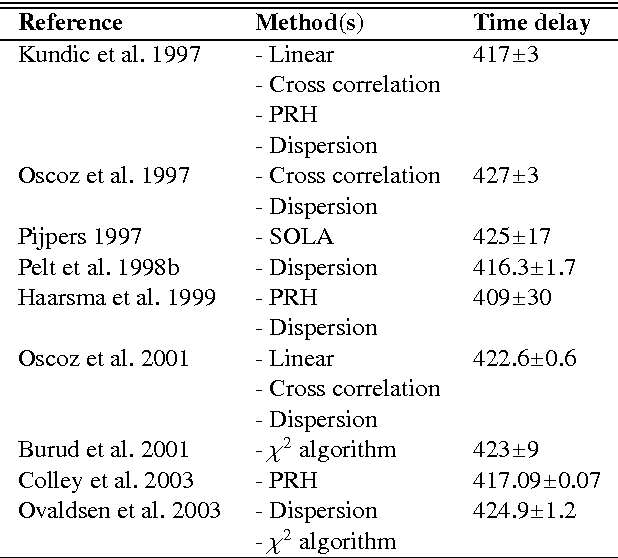
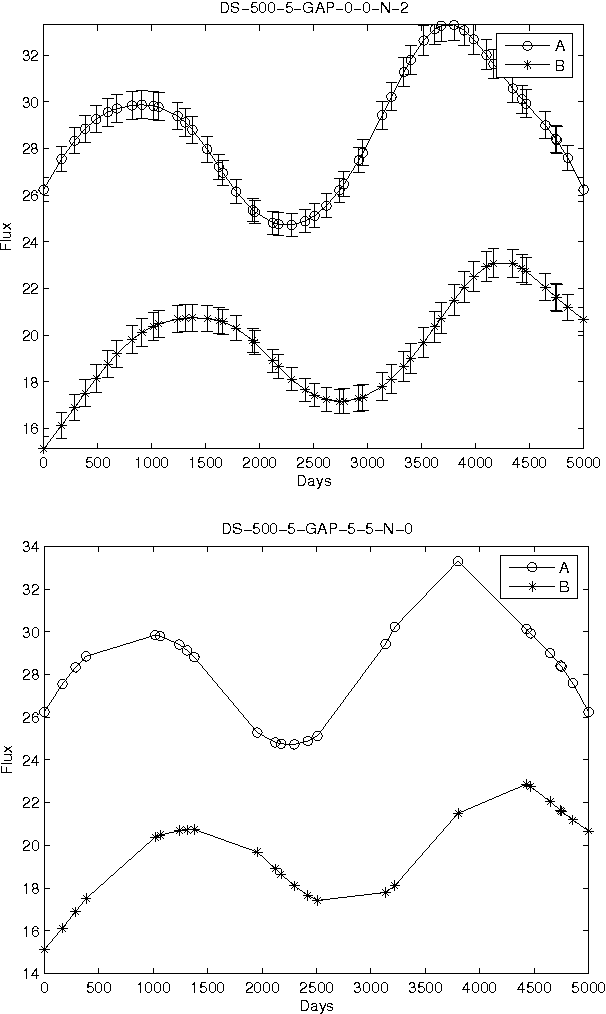
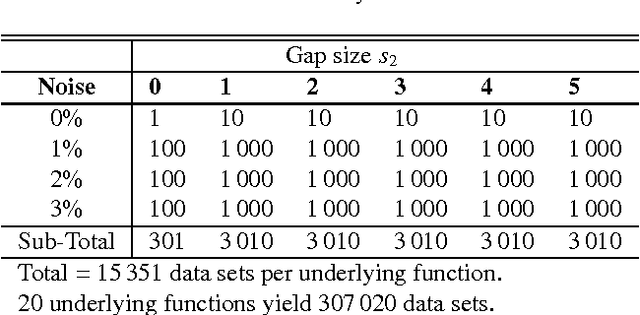
We present a novel approach to estimate the time delay between light curves of multiple images in a gravitationally lensed system, based on Kernel methods in the context of machine learning. We perform various experiments with artificially generated irregularly-sampled data sets to study the effect of the various levels of noise and the presence of gaps of various size in the monitoring data. We compare the performance of our method with various other popular methods of estimating the time delay and conclude, from experiments with artificial data, that our method is least vulnerable to missing data and irregular sampling, within reasonable bounds of Gaussian noise. Thereafter, we use our method to determine the time delays between the two images of quasar Q0957+561 from radio monitoring data at 4 cm and 6 cm, and conclude that if only the observations at epochs common to both wavelengths are used, the time delay gives consistent estimates, which can be combined to yield 408\pm 12 days. The full 6 cm dataset, which covers a longer monitoring period, yields a value which is 10% larger, but this can be attributed to differences in sampling and missing data.
* 14 pages, 12 figures; accepted for publication in Astronomy & Astrophysics